New clients often ask us: “Why should I do formal minutes for my business? Lots of lawyers don’t bother, and I have been told preparing annual minutes is an unnecessary expense.” Not so! If the business formalities are not observed, no matter the form in which you do business, you are exposed to liability as an individual. Such liabilities may include contract claims, claims for injuries to customers or employees, business tax liens, and other claims against you personally as a shareholder, limited partner, or LLC member.
Protection against assessment of personal liability for claims is important. Even if you have comprehensive liability and/or professional liability coverage there are limits to the kind and amount of coverage available. A corporation, Limited Liability Company (“LLC”), or Limited Partnership (“LPS”), is a legal entity with an existence separate from its owner or owners, and while this fact may shield your personal assets from liability, it will do so only if the formalities required to maintain the entity’s legal status are observed. If those formalities are observed, anyone with a claim or lawsuit is required to look to the assets of the entity for satisfaction, and may not pursue the owner(s) personally for recovery.
You may purchase professional or product liability insurance for your practice or company, but you cannot be sure that the amount of coverage available will be enough to protect you, and you must also consider the possibility of a lapse in coverage if you or your responsible employee misses a premium payment.
There is a means other than insurance available to protect against personal liability. That is to make sure the legal formalities required by applicable law for your business are observed. Keeping up to date company records, including formal minutes on a regular basis, is a relatively cheap price to pay for the additional protection provided against claims. The process of preparing regular minutes on an annual basis is an easy way for your lawyers to keep in regular contact with you, providing an annual legal “checkup” for your business to head-off problems before they arise.
Corporations Code §314 provides that written minutes of any meeting are “prima facie evidence of the matters stated therein. . . ,” and are admissible in evidence to establish the validity of the corporation if suit is filed to set aside the legal protection afforded by the entity. The same statutory protection is not specifically available to an LLC or LPS, but keeping detailed regular records at least annually for your LLC or LPS should provide protection. This is because the records are admissible in evidence to show that you respected the separate nature of your LLC or LPS, and thus help to exclude your personal assets from recovery in the event of a judgment. For corporations, as well as other business entities, such records can be crucial to avoiding personal liability if your insurance lapses due to employee error, or the policy limits are exceeded by the amount of the claim.
Preparing annual minutes also means the IRS is less likely to charge you personally, or look to your pension, profit sharing, or other retirement plan, to assess penalties if you are late to file or fail to make a required filing. Please call (310) 826-7900 with questions.

In 2014 the federal estate tax will continue to affect only the richest families in America. Under legislation passed by Congress in 2013 about 99.5% of all estates will not owe any federal gift/estate tax. Because most estate plans currently in existence don’t take the recent dramatic changes to the law and taxation into account, it is important that you have your current estate plan reviewed to make sure it is taking advantage of these changes. If you have not prepared a comprehensive estate plan, you should in order to ensure that your estate will be distributed to your beneficiaries as you have planned. Please call for an appointment.
Tax Rates for 2014:
The exemption amount is indexed for inflation each year, and in 2014 will be $5.34 million. Unlike legislation enacted in recent years, there is no “sunset” provision under the law enacted in 2013. Once indexed for inflation, the law will remain in force unless Congress acts to change the law again.
For those relatively large estates which remain subject to the tax, the gift/estate rate is 40%. This is also the rate applicable to what is known as the generation-skipping transfer tax (GST”). The GST is a federal tax that is imposed on large transfers made by those who seek to skip a generation to avoid taxes. For instance, a gift from a grandparent to a grandchild, which “skips” the grandchild’s parent.
“Portability”:
A significant feature of the current estate tax law allows a married couple to combine their estate tax exemptions. During lifetime or at death a couple may transfer more than $10 million to their beneficiaries free of estate taxes. This feature is called “portability.” Under the portability provisions, if the first to die doesn’t use all of his or her individual gift/estate tax exemption, the survivor may use what’s left of the decedent’s exemption. This effectively gives a married couple an exemption double the individual exemption. The couple may share their total exemption amount in the way that provides the greatest tax benefit.
For example, if each partner has $4 million in assets and the first to die leaves everything to the survivor no estate tax is owed. This is because property left to a spouse is tax-free under the so called “Marital Exemption.” When the survivor dies and leaves $8 million ($4 million plus the $4 million inherited from the other spouse) to the next generation no estate tax will be due, even though the combined estates are over the individual exemption amount. In other words, the survivor’s estate gets to “carry over” and use the first spouse’s unused exemption.
Note, however, that in order to take advantage of the portability rule a federal estate tax return on IRS form 706 must be filed within nine months of the first spouse’s death – even if no tax is due on that first death. As a result, the IRS must process returns that don’t provide any tax revenue, and taxpayers must pay for preparation of those returns. However, the benefit of portability for those with substantial estates will likely outweigh the additional cost on the first death. To take advantage of this feature your estate must be properly drafted.
In summary, there is continued good news on the estate and gift tax front for most Americans, and valuable planning possibilities for those fortunate enough to have an estate subject to wealth transfer taxes. Please call us with any questions.

The above captioned Act was passed by both houses on January 1, 2013, averting the much ballyhooed “fiscal cliff.” It became law on January 2, 2013.
SUMMARY
ATRA extends the Bush era tax rates, and provides as follows:
INCOME TAXES:
– Discharge of the qualified principal residence exclusion,
– The $250 above the line teacher deduction,
– Treatment of mortgage insurance premiums as residence interest,
– Deduction for state and local taxes,
– Above-the-line tuition deductions, and
– The IRA-to-charity exclusion, plus special provisions allowing transfers made in January 2013 to be treated as made in 2012.
BUSINESS PROVISIONS:
ESTATE TAXES: The Estate Tax regime will continue to provide an inflation adjusted $5,000,000 exemption, but will be applied at a higher 40% tax rate, up from 35% in 2012. Effectively, this means a $10,000,000 exemption for married couples.

January 4, 2013
The above captioned Act was passed by both houses on January 1, 2013, averting the much ballyhooed “fiscal cliff.” It became law on January 2, 2013.
SUMMARY – ATRA extends the Bush era tax rates, and provides as follows:
INCOME TAXES:
Discharge of the qualified principal residence exclusion,
The $250 above the line teacher deduction,
Treatment of mortgage insurance premiums as residence interest,
Deduction for state and local taxes,
Above-the-line tuition deductions, and
The IRA-to-charity exclusion, plus special provisions allowing transfers made in January 2013 to be treated as made in 2012.
BUSINESS PROVISIONS:
ESTATE TAXES:
FULL COVERAGE:
For a detailed statement of the bill, see: CCH (Commerce Clearing House) website document: LINK


December 10, 2012
To bring you up to date to the extent we are able to do so, based on the estate tax, gift tax and generation-skipping transfer tax provisions of President Obama’s 2013 budget proposal it will:

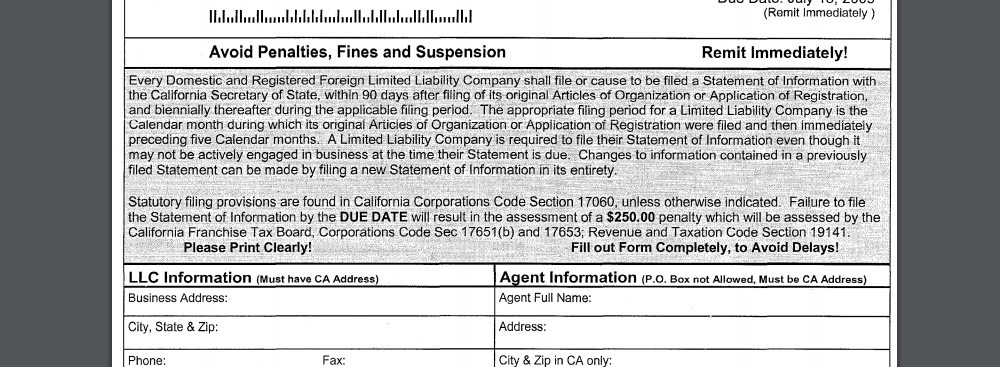
Be on the lookout for a scam being perpetrated on some of our corporate and limited liability company clients. A company which calls itself “Business Filings Division -California” is sending out an official-looking notice warning corporations and limited liability companies that they may be penalized and suspended unless they immediately pay $239 to file the required Statement of Information. You can view a sample of this form HERE.
Most of you are familiar with the annual Statement of Information form which is mailed out by the California Secretary of State to keep it up-to-date on your company’s address and the identity of its officers, directors, or members. That form is normally filled out by our clients themselves and mailed to the Secretary of State along with a $20 or $25 filing fee. The form can also be filed online at the Secretary of State’s Website.
This is deceptive advertising despite the disclaimer in the last paragraph of the notice which states “this offer is not being made by an agency of the government.”
I repeat, the filing fee is $20 for LLC’s and $25 for corporations if you file this yourself! Similar scams are being run with respect to keeping your annual minutes up-to- date. Unless you see our letterhead, you should ignore these notices, too. Although I doubt there is a problem, you can check on the status of your company by giving us a call and we will check your status for you and get you back in compliance if there is a problem.

Attorney Grant Hardacre is featured in this recent article published on FOX NEWS
Sunday , April 12, 2009
LOS ANGELES —
Like many Californians who put down roots in earthquake country, Robin Rudisill knows the “Big One” could strike without warning. Yet from her Venice beachfront duplex, Rudisill worries about a different massive blow from Mother Nature — a tsunami.
Her 1950s-era home — with its cool ocean breeze and golden sunsets — sits smack in the heart of a potentially deadly tsunami zone. If that big one ever came ashore, scientists say, it could raze the landscape from the sun-kissed beach to about a mile inland.
To alert homeowners and beachgoers that they are in tsunami territory, the city of Los Angeles has begun posting blue and white “TSUNAMI HAZARD ZONE” signs with an image of ominous-looking waves. The signs, which have surfaced in beach parking lots and at major intersections in Venice and other low-lying communities, also point out evacuation routes.
“It makes it clear that we are in an inundation zone, which most people did not previously, and many still do not, know,” said Rudisill, who pushed for the signs.
While a tsunami threat to the Golden State is real, the potential for killer waves is far less likely than the earthquakes, wildfires, landslides and floods that plague the nation’s most populous state.
According to scientists, there’s a 99.7 percent chance that California will be struck by a magnitude 6.7 earthquake or larger in the next 30 years. No such calculations exist for the potential of a tsunami.
The 2004 Indian Ocean tsunami that wreaked havoc to Indonesia, Thailand, Sri Lanka and India jolted U.S. cities on both coasts to review their emergency plans.
Devastating tsunamis have pounded North America in the past, with California, Hawaii, Alaska, Washington, Oregon and the Caribbean islands most at risk.
In California, tsunami signs already are up in parts of Orange County and in several seaside Northern California counties, where the tsunami danger is greater. Beachfront communities are responsible for securing their own funding for the tsunami displays — a first step in preparing for a potential disaster.
Tsunami waves can be raised by underwater earthquakes, submarine volcanoes or coastal landslides. If a powerful undersea quake rattled the Pacific Rim, the first waves could reach the California coast hours after the shaking stops. That time is cut to mere minutes if one hit closer to shore — not enough time for authorities to send out a warning.
“A large local tsunami hitting on a summer afternoon with hundreds of thousands of people on Southern California beaches could cause Thailand-like devastation. This is why we rely on the signs,” said tsunami expert Costas Synolakis of the University of Southern California.
A 2005 study by the California Seismic Safety Commission found that a tsunami generated by a large offshore quake would threaten at least 1 million coastal residents and swamp the nation’s largest port complex. The same report also found gaps in the state’s readiness to handle a tsunami.
Since 1812, 14 tsunamis with waves higher than 3 feet have been observed along the California coast, but only six caused destruction. The deadliest occurred in 1964 when a magnitude-9.2 quake in Alaska spawned tsunami waves that killed 12 people in Northern California.
While devastating tsunamis are rare, emergency responders are concerned because of increasing development along the coast.
Last winter, Los Angeles spent about $8,000 to post 60 signs in Venice, Pacific Palisades and coastal communities near the Los Angeles International Airport. The city plans to use a $350,000 federal grant to install more signs as early as this summer.
“It’s for public safety. The more people know about it, the better they’re prepared for an emergency,” said Richard Deppisch, the city’s emergency preparedness coordinator.
Some beachgoers say the signs are useless without emergency sirens to warn tourists and residents of incoming waves.
“If it happens at night, no one is going to be on the beach to say, `Run away,”‘ said E. Grant Hardacre, a lawyer and surfer.
Los Angeles County, which is considering posting signs in unincorporated areas, currently broadcasts emergencies through television and radio. While the county has studied using sirens to warn about a tsunami or other natural disasters, there are no current plans to activate them, said Jeff Terry, the county’s tsunami coordinator.
Don Howe, a senior transportation engineer with the California Department of Transportation, said the signs are experimental and the department is collecting feedback.
Police in Humboldt County near the Oregon state line recently grappled with a string of sign crimes. Last year, about 5 percent of the 400 signs posted on state highways and county roads were stolen, damaged or vandalized. No arrests have been made.
“It’s tapering off,” said Brenda Godsey, a spokeswoman with the Humboldt County Sheriff’s Office, said of the sign tampering. “The novelty of the signs is waning.”
Late last month, coastal counties received draft tsunami maps from the state pinpointing beach towns prone to flooding. The maps, which were updated from ones made after the 2004 Indian Ocean disaster, are intended to help local governments identify places where people can evacuate to higher ground or consider building evacuation shelters.
For Venice Beach resident Rudisill, living steps away from the sand is a mixed blessing. While she has easy access to the water, she also worries about the possibility of a tsunami.
Two years ago, Rudisill channeled her worry into action. Along with neighbor Darryl DuFay, who lives in the Venice canals, the duo held an information meeting with members of the local neighborhood council.
Despite living in the path of a tsunami, Rudisill cannot imagine making her home anywhere else.
“The daily joy I get from living here is worth all those risks we face,” she said

RECORDS RETENTION GUIDELINES
I. STATUTORILY REQUIRED RETENTION PERIODS (by category of documents):
(1) ERISA Records:
6 years after documents were filed or would have been filed but for an exemption
Documents to be retained are records on matters required to be disclosed that provide in sufficient detail the necessary basic information and data from which any information filed under the Act can be verified; for example, employee communications, administrative reports and official filings.
(2) Cal-OSHA Records:
5 years following end of calendar year to which they relate
Documents to be retained are the (1) Log and Summary of Occupational Injuries and Illnesses or equivalent, and Supplementary Record and (2) Annual Summary of Occupational Injuries and Illnesses.
(3) Employment Applications:
4 years
(4) Employment Records:
Indefinitely for current employees – varying periods for former employees
Documents relating to employment contracts of former employees should be retained for a period of 4 years after termination. See comments relating to payroll records and employee benefit plans as they may relate to individual personnel records.
(5) Payroll/Wage Records:
4 years after tax is due or has been paid
Documents containing information sufficient to support the tax filings must be retained for this period. Time cards and other documentation submitted by individual employees need to be retained for only 2 years provided there are other records to verify the amount of taxes paid.
(6) Employee Benefit Plans:
1 year after the plan has been terminated
II. RETENTION PERIODS NOT REQUIRED BY STATUTE (By category of document)
The following time periods are not required by specific statutes, but are recommended for the reasons stated:
(1) Contracts:
4 years after the end of the term.
(2) Tax Returns and Supporting Records:
7 years for federal, state and local taxes
Your Finance Department may have its own guidelines for retention of records relating to income, sales and property taxes, which may be more or less than 7 years.
(3) Documents relating to Product Claims (e.g., complaint letters):
1 year for personal injury complaints, and 3 years for breach of warranty complaints
If you maintain a summary report on a yearly or other periodic basis which records number of products sold, number of complaints, types of complaints, etc., you may want to retain the summary reports for a period of 3 years, or more if this type of information is important to retain for historical purposes. Such information can be helpful if a complaint results in litigation, particularly if the summary reports show that the number of complaints or injuries in relation to the number of products sold are very low.
(4) Formulae and Formulation Information:
Indefinitely
This type of information should be retained indefinitely and duplicate copies of the formulae should be held for safe-keeping in a fire-proof file cabinet or off-site location.
(5) Product Development and Advertising Information:
The retention time should be decided by management
Management should decide what type of information is valuable to retain to assist with further product development and advertising.
(6) Trademark/Patent Information:
Indefinitely
Information relating to registrations should be retained not only during the periods of registration, but for a longer period of time to provide a history of the marks. Management should decide what type of documents, in addition to the actual applications and registrations, should be retained.
(7) SEC Material:
Indefinitely
The SEC filings for the company should be retained indefinitely. SEC filings for individual employees are to be retained in accordance with guidelines for employment records.
(8) Corporate Records (Charter Documents):
Indefinitely
Management should decide what type of back-up documentation should be retained that relates to contracts and official corporate records, such as articles of incorporation, LLC or partnership documents, by-laws and minutes.
(9) Documents regarding Litigation/Disputes:
Until final disposition of the case and no less than 4 years thereafter
Some settlement agreements should be kept indefinitely.
(10) Email and voice mail
For email, depending on subject matter, review and clear or use alternative storage twice each year
For voice mail, review and clear weekly
(11) Computer Hard Drives:
Unless there is litigation pending and there is relevant information stored on your company’s hard drives, we recommend that you set up a procedure for review and possible clearing of data storage at least twice a year. Material which should be retained can be printed for storage, or stored electronically, following the above guidelines.
Generally speaking, our office retains all client records for 7 years after litigation or cessation of business by the business entity.

TABLE OF CONTENTS
INTRODUCTION
TRUSTS
DEATH TAXES
PROBATE
I. WILLS OR TRUSTS TO TRANSFER ASSETS?
A. Saving Taxes – Trusts Offer No Tax Advantage Over Wills
B. Avoiding Probate Is Not Always Wise
(1) Delay in Distribution of Your Estate
(a) Trusts and Probates Must Wait on The Tax Man
(b) Reform Has Streamlined the Probate Process
(c) A Problem In Probate Is A Problem In A Trust
(d) Trustees Often Submit Your Trust to Probate Jurisdiction Anyway
(2) Ease of Transfer of Assets
(a) “Wild Card Assets” Plague Trusts
(b) Trust Beneficiaries May End Up In Court
(3) Excessive Compensation
(a) Trusts Cost More To Set Up
(b) Unregulated Fees Make Trusts More Expensive Than a Probate
II. A WILL OR TRUST? OTHER CONSIDERATIONS
A. Dependents are Protected By A Will Or A Trust
B. Living Trusts Offer No More Privacy Than Wills
C. Better To Litigate In Probate Than With A Trust
D. Probate Provides For Family Support
III. ALTERNATIVES TO REVOCABLE TRUSTS
A. Wills
B. Other Alternatives
1. Real Estate
2. Personal Property
SUMMARY
INTRODUCTION
The revocable living trust is also known as the “family,” “intervivos,” “living,” or even “loving” trust, and has become the vehicle of choice for almost all estate plans.
There are many estate planning situations where a trust is appropriate. During our fifty years of service to our clients, we have used the revocable trust for their benefit when it is appropriate to do so. For some of our clients over 55, and most over 65 we recommend a revocable living trust because of the fact that it permits management of a disabled person’s estate without the need for a cumbersome and expensive court conservatorship. The conservatorship process, whereby a relative, friend or care giver seeks appointment by the court to completely take over and manage a person’s estate while the ward is still living is to be avoided unless there is no one who can be trusted to administer a private trust. However, in the event of death, the widespread use of the “revocable living trust” as the estate planning and administration device of choice has many times turned out not to be in the interest of the client or the client’s beneficiaries.
We are concerned that many people enter into these trusts without fully understanding what it is they are buying. The problem we see is that the revocable trust often fails to provide the advantages claimed for it and there are cheaper and more efficient legal vehicles available to do the job the living trust is supposed to do. Too often the revocable trust is promoted as a wealth transfer device when it is not appropriate to do so.
What we want you to know is that there is nothing wrong with using a will to transfer assets in many estates, even substantial estates. A will can do as well as or better than a revocable trust to protect your estate from creditors, lawsuits, audits, and heirship claims and do it for less money. To understand why this is so, you need to know some basic facts about trusts, taxes and probate.
TRUSTS
WHAT IS A TRUST? The trust form of property ownership was devised in England long ago to permit legal title to be transferred by the owner of property (the trustor or settlor) to another person (the trustee) for the benefit of the trustor/settlor or a third person (the beneficiary). With a trust, the beneficiary does not have legal title to the property, but has the right to enjoy the use and benefit of the property placed in trust according to the terms of the trust (this is known as a “beneficial interest”).
Trusts can be established for varying lengths of time, even for several lifetimes (but not in perpetuity, except in a few states), or can be revocable, that is terminable at the whim of the settlor or upon certain conditions or events specified by the settlor.
HOW DO YOU CREATE A TRUST? By signing a deed, declaration, or agreement, all of which are effective to create the trust immediately, or by signing a will, which is effective to create the trust only on your death.
WHAT IS THE PRACTICAL DIFFERENCE BETWEEN A REVOCABLE TRUST AND A TESTAMENTARY TRUST? None. The only difference is that a trust established on your death by a will is called a “testamentary trust,” and a revocable trust established before your death is called a “living trust.” Both forms become irrevocable on your death. A testamentary trust provides the same protection as a revocable trust for your beneficiaries.
A revocable living trust is supposed to transfer your assets on your death without a proceeding in probate court. To do this, it must be funded while you are alive. A revocable living trust used to transfer your assets is not subject to court control like a testamentary trust, although a beneficiary can petition the probate court to take jurisdiction of the trust. Very often the successor trustee is a bank. Our position is that once you are gone, your trustee’s actions, particularly if it is a bank, should be subject to probate court review and accountability to protect the trust estate from abuse, particularly overcharging.
DEATH TAXES
We do not have a death tax in California. However, your estate may be liable for federal estate tax. Beginning in 2009, no federal estate tax will be due in estates valued at less than $3,500,000 for single persons, and $7,000,000 for married couples who plan properly, and the death tax will be fully repealed in 2010, although the “sunset” provisions of the Byrd Amendment (which is intended to avoid a federal deficit), will reinstate the tax in 2011 as it existed in 2000 unless Congress votes to override that Amendment.
Regardless of the size of your estate, if you are married when you die, the 100% federal estate tax marital deduction is available to your spouse. This means that there is no tax due at the first death, no matter how large the estate. Tax is imposed on the spousal estate only after the surviving spouse dies. However, if one spouse dies without using his or her exemption, only the second spouse’s exemption will be available on the second death.
If a married couple sets up a simple “bypass” trust for the survivor and places $3,500,000 of marital property in that trust on the first death, the decedent’s lifetime exemption is preserved, and a total of $7,000,000 can go to the heirs tax free. A bypass trust does not require a living trust, but can be set up in your will along with trusts for the protection of children or other dependents.
PROBATE
While it may be desirable to transfer your assets without filing a petition in probate, at least if you have no tax problems or disgruntled heirs, probate is not something to be shunned and feared out of hand. Probate is a shorthand way of describing the court supervised procedure designed to pass your property as you have instructed in your will, while protecting your heirs. Many people don’t really know what probate is or what it does, and do not realize that probate avoidance may have a high price if a revocable living trust is used as a will substitute to avoid probate. For married clients, formal transfer procedure can be avoided on the first death by simply holding title in co-tenancy. We will discuss this and other less expensive alternatives after comparing wills and revocable trusts as estate transfer devices.
I. WILLS OR TRUSTS TO TRANSFER ASSETS?: The two major selling points used to promote revocable trusts are: (A) saving taxes, and (B) avoiding probate.
A. Saving Taxes – Trusts Offer No Tax Advantage Over Wills.
Now that you have an overview of the death tax applicable to your estate, we can examine the tax advantages of revocable trusts over wills. There are none. Nevertheless, our clients who have attended lectures, read estate planning articles, or been advised by well-meaning relatives and friends, are often under the mistaken impression that the revocable living trust is a device to save taxes. It is not. Rather, it can result in excessive fees and costs in the short and the long run, with no tax benefit over a will.
When it comes to taxes, a revocable living trust has no advantage over a testamentary trust set up under a will. This is because of a basic fact of life and the cardinal rule of tax planning – you don’t get something for nothing. In order to effect a tax savings with a trust, or otherwise, you must give up something. The thing you must give up is control of your estate while you are alive. Therefore, the only trust that can effectively save you taxes is an irrevocable trust. Once you’re assets are in an irrevocable trust, there’s no getting out of it or changing it, regardless of changes in your circumstances or wishes. For this reason living trusts used as will substitutes must be revocable.
The fact that your estate planning trust is revocable means that its legal effect is identical to that of a will. A will does not have any effect on your property until your death and can be changed or revoked at any time.
B. Avoiding Probate Is Not Always Wise. The principal reasons given for avoiding probate are: (1) eliminating perceived delay in distribution of the estate; (2) making it easy to transfer assets to your heirs, and (3) avoiding excessive compensation to lawyers and executors. Let’s look closely at the supposed benefits of probate avoidance:
(1) Delay in Distribution of Your Estate. For most estates that we administer there is no difference in the amount of time required to distribute an estate under a will or a trust. The reasons for this are:
(a) Trusts and Probates Must Wait on The Tax Man. Whether you use a will or a trust, if a federal estate tax is due because the value of your estate exceeds the available estate and gift tax credit, it will take at least six months to transfer all of your estate to your beneficiaries. This is because the federal estate tax law gives your executor or trustee the choice of valuing the estate either as of the date of death or a date six months later. Both a trustee and an executor must wait for the alternative valuation date to pass before distributing your estate, or risk overpaying death tax. In fact, the federal estate tax return is due nine months after your death, and most estates stay open at least that long, even if a revocable trust is involved.
(b) Reform Has Streamlined the Probate Process. In response to criticism of the probate system nationwide, remedial statutes have been passed streamlining the system and eliminating most of the perceived problems. Ironically, California, where the revocable trust device has found perhaps the greatest favor, has been for many years an example of progressive and efficient probate administration. The Probate Division of the Los Angeles County Superior Court pioneered progressive methods of court administration which were followed in many other parts of this state and others. The passage of the California Independent Administration of Estates Act several years ago gave executors much more flexibility and freedom in administering probate estates without time consuming and costly court supervision, while maintaining essential protections for heirs, creditors and the taxing authority.
(c) A Problem In Probate Is A Problem In A Trust. Even if your estate owes no estate tax, your trustee must pay claims, handle property transfers, wind up your business affairs, and settle heirship proceedings or law suits before he or she releases the assets to your beneficiaries. It is true that it is possible (although rare) for a trustee to distribute trust assets earlier than an executor distributes assets in probate because an executor must allow the creditor’s claim period to run before closing probate (four months in California). Once the probate creditor’s claim period has run, creditor’s claims are barred. Far from being a hindrance to distribution, the protection of the probate creditors claim statute has now been made available for trusts, and many trustees elect to subject trust assets to probate jurisdiction to take advantage of the four-month time limit for filing claims.
(d) Trustees Often Submit Your Trust to Probate Jurisdiction Anyway. For years the revocable trust has been sold as a probate avoidance device, but now that people are dying with revocable trusts in place (they become irrevocable on death, remember), the post death administration of these trusts not only looks like a probate, but is in fact becoming a probate proceeding.
Due to the failure of the revocable trust to perform effectively as a will substitute (and an upsurge in trust litigation), a number of new provisions have been “cobbled” onto the California Probate Code in the last few years to try to solve some of the problems facing trusts and trustees as they struggle to deal with issues already addressed in the probate of a will. Division 9 of the Probate Code has been expanded to cover creation and validity of trusts, trust administration, powers of trustees, liabilities of trustees to beneficiaries, judicial proceedings concerning trusts, liability of trustees to third persons, and, as stated above, payment of claims, debts, and expenses of a deceased settlor. These new provisions allow your trustee to invoke probate court jurisdiction to resolve any issues he or she may be worried about, but at your trust’s expense and without fee regulation.
(2) Ease of Transfer of Assets. If the trust is properly set up, and maintained, your assets will be transferred quickly and efficiently. The problem is that proper set up and maintenance does not often occur. In fact, the revocable trust device often results in a more complicated and difficult transfer procedure following your death than is the case with a will. There are two reasons for this: (a) an inherent problem of the revocable trust device is that assets are often left outside the trust and require the use of both a probate and a trust administration (we call these “wild card assets”), and (b) even if all of your assets are transferred to the trust, there is no one pushing your trustee to meet deadlines and transfer those assets. In probate, the Court routinely reminds counsel and the executor of deadlines and insists that the matter go forward expeditiously.
(a) “Wild Card Assets” Plague Trusts. You must transfer all your assets to your revocable trust if it is to work as planned. Anyone who adopts a living trust will find that the lawyer who drafts the trust with the purpose of avoiding probate, always insists that the client have a will as well as a trust. The lawyer will tell you that this is to take care of any assets that are not transferred to the trust. This happens more often than you might think. Rather than have such assets “fall through the cracks,” the will that accompanies all revocable living trusts provides for transfer of any “wild card assets” to your trustee when you die, but that won’t happen until they have been through probate. Revocable trusts are promoted precisely because they are supposed to permit your estate to avoid the dreaded probate courts, but many estates end up with a probate and a trust administration.
(b) Trust Beneficiaries May End Up In Court. In probate, your executor and his or her lawyer are required to meet deadlines for filing your estate inventory, for paying your bills, and winding up and distributing your estate. If they don’t meet the deadlines, the court sends a letter demanding action. If they still don’t respond, they may be hauled into probate court and see their fees reduced, or they may be replaced. No such system exists for trusts. There is a real chance that an unregulated trustee may drag his or her feet, failing to communicate with beneficiaries, and not accounting for their actions. In California, beneficiaries have been given the means to force trustees who delay or even refuse to account or make distribution to toe the mark, but that requires your beneficiary to file a trust petition in probate court.
(3) Excessive Compensation. If your estate is held in a revocable trust at your death, it can end up in a probate proceeding anyway. Disputes following death can arise in a trust setting also. If that happens, about the only protective provisions of the probate code not applicable to your trust are provisions limiting the freedom of trustees and their lawyers to charge fees. Provisions do exist in probate to regulate fees of executors and their lawyers, but none exist with living trusts. This is a truly ironic result, given the fact that a major selling point for revocable living trusts is avoidance of supposedly excessive fees in probate. If he believes they are excessive, a trust beneficiary may petition to reduce fees, but must file a petition and appear in probate court to do this.
In fact, living trusts usually cost a great deal more than wills to set up. In addition, unregulated trustee fees following your death are often higher than probate fees for an estate of comparable size. If you pay for a revocable living trust, it is often with the desire to save on lawyers’ fees and other administration expenses. Let’s examine the facts about compensation for estate planning and for estate administration and its impact on your desire to save money for your beneficiaries:
(a) Trusts Cost More To Set Up. A revocable trust does not save fees. It costs more to set up a trust than to execute a will which, in our offices, ranges from $500 for a very simple will to $1,500 for a will which includes a testamentary bypass trust for married couples to make sure each spouse’s federal estate and gift tax lifetime exemption is used so that the maximum exemption is obtained, and a testamentary family trust to protect children and grandchildren, if any.
In comparison to wills, revocable trusts are often hugely complex, some with more than fifty typed pages. Fees quoted for revocable living trusts range from $2500 to $7,500 and often more.
(b) Unregulated Fees Make Trusts More Expensive Than a Probate. In most states, lawyers’ fees in a decedent’s estate are fixed by statute, and in California they are set as a percentage of the value of the estate However, this was not done because lawyers wanted it! In California, fee regulation came about in the early part of the Twentieth Century because, without regulation, there were wide swings in the cost of estate management and distribution unrelated to the value or complexity of the estate. The only criterion for setting fees was “whatever the traffic will bear.”
The legislature responded with a two-part system for the control of compensation for executors and their lawyers, adopting the concept of statutory and extraordinary compensation.
Statutory (sometimes called ordinary) fees are fixed as a percentage of the value of the estate, including gains and losses on sale of assets., and cover run of the mill services normally required to transfer your assets to your heirs. This includes locating and listing your assets, preparing an inventory, paying claims, and distributing the assets to your heirs and beneficiaries.
In the case of fees for statutory or ordinary services, the court is prohibited by the statute from allowing more than 70% of statutory fees until the estate is actually closed and distributed. Trusts have no such hold back.
In probate, any services of an unusual or extraordinary nature are also covered by statute, but are not paid as a percentage of the estate. They are awarded only after a hearing in court on a written fee petition. Extraordinary services involve such things as preparation of estate tax and income tax returns, tax audits, litigation and settlement of substantial disputes with heirs, creditors or other claimants. Remember, if your estate has problems which may result in “extraordinary” compensation in a probate, it will have those problems whether it’s administered under a “revocable trust” or in probate court.
In the case of fees for extraordinary services, fees are rarely allowed by the court until the particular extraordinary matter is resolved. The lawyer must tell the court in writing what he or she has done and how those services benefit the estate to justify an award. A judge or the court probate staff looks at the written fee application and weighs all these factors very carefully. Generally, probate extraordinary fees are awarded at a rate of 10-30% less than the going hourly rate of most lawyers in the community.
The important thing to note is that lawyers’ fees in a probate setting are regulated, either by the statutory table or by the review of a skeptical judge. Contrast this with a revocable trust where there is no review or regulation. In the case of a trust, the trustee and the lawyer are paid unregulated fees at whatever rate they may set, and they may collect monthly, even if the estate has not been distributed. Therefore, ask yourself what incentive they have to administer the estate efficiently of quickly.
A probate lawyer is not bound to charge the full statutory fee and can take less. It has been our custom to enter into agreements with our clients or their heirs which limit our statutory fee to an amount calculated by multiplying the number of hours which we spend in connection with the probate administration times our normal hourly rate, or by applying the statutory fee table, whichever fee is less. Tell your executor that this sort of fee arrangement is possible and that he or she should negotiate with the lawyer who will do the probate work. If the lawyer will not agree to such a fee arrangement, your executor should take the probate somewhere else.
Compensation paid for the services of a lawyer or an executor is a tax deductible expense of the estate. The executor has the choice of deducting compensation on the federal estate tax return or the estate’s income tax return.
II. A WILL OR TRUST? OTHER CONSIDERATIONS: Additional advantages often cited in favor of the revocable trust include protecting minor children and incompetents, securing privacy, avoiding litigation, and providing a ready means of supporting family members during estate administration.
A. Dependents are Protected By A Will Or A Trust. We generally suggest that wills provide for a trust if there are minor children, or if you must care for someone who is not mentally competent or is unreliable. Provisions in testamentary trusts set up by a will to do this job are identical to the provisions used in living trusts.
B. Living Trusts Offer No More Privacy Than Wills. At least in California, the so called “privacy” of the revocable living trust is, for all practical purposes, nonexistent and never was meaningful.
Before your death a will is an absolutely private document, after your death, it must be filed with the probate court. This probate filing is not a bad thing unless you are a rock star whose family will be hounded by the pulp newspapers, or a reclusive billionaire with secrets to hide who sets up a trust for that reason. However, even if you are a rock star or an eccentric, you can no longer keep your final wishes a secret using a living trust. Your trustee must divulge the terms of your trust to all your potential heirs. The California Probate Code now provides that once a trust, or part of a trust, becomes irrevocable (upon the death of a spouse, for instance) the trustee must give notice to potential heirs and deliver a copy of the trust on request.
Even before your death trust privacy is circumscribed. You cannot sell real estate or stocks without showing the buyer or transfer agent your revocable trust, or a summary prepared by your lawyer under the probate code, which summary must be paid for by you. In a lawsuit, the other side can discover the provisions of your trust. With a will, at least pre-death privacy is assured.
C. Better To Litigate In Probate Than With A Trust. If you die and leave unpaid creditors, unhappy business partners, heirs who have potential disputes, tax problems, etc., your representative, whether a trustee or an executor, is faced with identical problems. Having a trust won’t stop a litigant from suing. If a suit is filed after your death, your trust ends up in civil litigation instead of the less formal, usually more efficient and responsive probate court system. In Los Angeles County (and most other counties) there is a professional staff of attorneys and assistants who review, prepare and comment to the judge on all proceedings. Because of this, matters which might otherwise drag on in the civil courts are often disposed of at the procedural level or in settlement.
D. Probate Provides For Family Support. You may hear that with a will your money can be tied up in probate with no immediate provision for protection of surviving family members. This is not so. When your spouse dies, co-tenancy bank accounts can make it easy to obtain funds immediately without a trust. On the second death, when a probate may be required, the California Probate Code allows dependents (or their guardians) immediate access to funds by way of the probate family allowance, as well as the right to live in the family residence during probate, without the delay of a court hearing. The fact that the court continues to have jurisdiction over the amount and duration of family allowance payments is a positive. The court will not allow excessive payments and will not let them continue to the detriment of the estate.
III. ALTERNATIVES TO REVOCABLE TRUSTS. One purpose of the revocable trust if you are married is to transfer title to your spouse without going through probate. However, you do not need a revocable trust to achieve this goal. A will is an obvious alternative and, if you are married and do not have a complex estate, we recommend that you hold your community property with your spouse as “Community Property With Right of Survivorship” instead of in a revocable trust. See ¶B. 1., below.
A. Wills: A will is the most obvious alternative to a complex revocable trust and should be used in most instances when a client’s estate does not exceed the federal estate and gift tax lifetime exemption. This may mean a probate (unless, in California, the estate is worth less than $100,000 and there is no real estate), but that is not something to be avoided by the application of the revocable trust device where it makes no economic or practical sense.
B. Other Alternatives:
1. Real Estate: Beginning in 2002, a married couple can avoid probate of real estate without a trust by holding real property as “Community Property With Right of Survivorship” (California Family Code §750). This form of ownership assures California couples that when one of them dies, the other will receive a full step up in basis of all the community property for federal income tax purposes, while retaining the survivorship benefits of joint tenancy.
With the advent of Community Property With Right of Survivorship under California Civil Code §682.1 (operative July 1, 2001) you don’t have to have a probate or other court proceeding to transfer property to you on the death of your spouse. A simple “affidavit death of spouse” can be used to clear title to assets. If it is advisable for income or estate tax reasons to have a court proceeding, you may use the inexpensive, streamlined spousal property confirmation petition now available in California. You do need wills for each spouse to transfer what’s left on the second death. Your wills may or may not contain a trust for minors or other dependents, and a “bypass” trust if you have a fairly large estate and want to take full advantage of the lifetime federal estate tax exemption granted to each spouse.
2. Personal Property: In California (Probate Code §5100, et seq.), and many other states, bank accounts, stocks and other intangibles held in the names of both husband and wife, are transferred upon presentation of a death certificate without the need for court proceedings or a trust. Community property with right of survivorship is also an inexpensive and practical way to transfer any property between spouses.
SUMMARY
Remember that we stated at the beginning of this article that Revocable trusts are definitely not panaceas, and are often oversold, although they have their place in an appropriate setting. For instance, we may recommend a revocable living trust for incapacitated persons, or those with debilitating illnesses, or those over age 65 who wish to delegate management of their estate assets without giving up all control, or where the client owns assets in several states or countries (particularly real property), or owns intellectual property which requires ongoing management during his or her lifetime and after death. However, we use revocable trusts only when there is a good reason for doing so. This is in large part because of the additional drafting and set up expense and the problems of unregulated fees post death, and especially in the event of litigation over the estate.
Feel free to call us with any questions.
What goes into a blog post? Helpful, industry-specific content that: 1) gives readers a useful takeaway, and 2) shows you’re an industry expert.
Use your company’s blog posts to opine on current industry topics, humanize your company, and show how your products and services can help people.

In order to assist our clients who are considering a dissolution of their marriage, or divorce as it is commonly known, this article explains basic California community property laws.
California is what is known as a community property state. The theory behind the community property system is that marriage is a partnership, and that property acquired during the marriage by the labor or skill of either party belongs to both in equal shares, and may be divided between the parties by a court in the event of death or the legal dissolution of marriage.
The basic rule is that the court must divide the community property assets and debts equally so that “net” values (i.e. assets less liabilities) received by the respective parties are equal. On the other hand, the parties to a marital action may divide their community estate by agreement, in which event they are not limited by the equal division requirement.
Generally, the earnings, income, and benefits resulting from the services and efforts of either party during marriage are community property. Separate property, defined as all property which is not community property, includes all property 1) owned by a spouse before marriage, 2) acquired during marriage by gift or inheritance, 3) produced by separate property, or 4) acquired after the date of separation. A court generally has no authority to dispose of either spouse’s separate property during a legal proceeding for dissolution.
Spouses may by written agreement change the character of their property from community to separate or vice-versa. They usually do this with a pre-marital agreement which is a formal written contract executed by the parties before marriage.
Normally, no agreement is necessary to preserve the separate character of a spouse’s property owned before marriage, together with the income and appreciation derived from that property during marriage.
Because income arising from a spouse’s skill and effort during marriage is community property, the law provides that the other spouse is entitled to a fair share of the economic benefit derived from a spouse’s significant effort to improve his or her own separate property. The same rule applies when one spouse devotes time and effort to improving the other spouse’s separate property. As result, the management by one spouse of either spouse’s separate property may sometime result in a community component to the separate property asset.
Divorced spouses lose inheritance rights in the other’s property. These rights include the right, as a surviving spouse, to inherit the other spouse’s half of the community property, and the right to inherit at least one-half the value of the other spouse’s separate property if that spouse dies intestate, that is, without having made a valid will. We recommend that as part of a comprehensive plan of marital and estate planning our clients execute a new will or trust which refers to the former spouse and states the marriage was dissolved by a court.
In marital dissolutions, the court may order either spouse to pay a sum necessary for the support of the other spouse (formerly known as “alimony”). There are two types of spousal support: temporary and permanent. Temporary spousal support is generally payable pending final judgment of dissolution of the marriage. Courts employ a software program that uses a set formula for calculating temporary spousal support payments based on the respective incomes of the parties, less certain deductions. This is what is commonly known as “guideline” support. The court has little or no discretion to deviate from guideline spousal support.
Before or after the court enters a judgment of marital dissolution, the court may order permanent or long-term spousal support which is payable in any amount and for any period of time that the court deems just and reasonable. However, the court will base its decision upon consideration of the parties’ standard of living established during the marriage and a detailed set of other statutory factors.
It is the goal of the courts that the supported party be self-supporting within a reasonable time. In short term marriages (generally accepted as those of 10 years or less), the rule of thumb for duration of support is about half the length of the marriage, and frequently less if the party asking to be supported is young, educated and has marketable skills. The longer the marriage, the more likely it is that a court will set no date for termination of support. In other words, a party to a long term marriage, say more than 15 years, could be supported for the rest of his or her life, especially if the supported party forgoes an education, career, or profession in order keep the family home and/or raise the children of the earning party. If there is a change in circumstances, either spouse can come back to court and ask for a change in the support obligation.
Waivers of spousal support by either spouse are permitted, so long as the waiver is reasonable and the parties understand the consequences. The parties can either waive forever their rights to spousal support, or instead, waive their rights for the time being with the court “reserving jurisdiction” on the issue of spousal support.
The court may order either spouse to pay a sum necessary for the support of the parties’ children. The ability to ask a court for child support may never be waived. Courts employ the same software program used to calculate temporary spousal support to calculate child support payments.
Now that you are armed with a basic knowledge of the law, you are in a position to consider what shape your marital dissolution agreement will take, taking into account economic realities. We look forward to your input and hope this memorandum helps serve your goals.
If you have any questions, please do not hesitate to call.